
 |
| The Grey Wolf shares 99% of the DNA with all K9's Photo Credit: Flickr user Dallidee |
Creation
 |
| A statue of a Molosser, Credit: Flickr user Quinet |
There are different theories on how Grey Wolves became domesticated. Many of these theories revolve around the idea that humans domesticated wolves to benefit from them in some way, or in other words, to put them to work.
Modern day DNA testing has provided us with a wealth of knowledge of the subgroups which make up the different breeds we have today. However, before the use of DNA, it was thought that there were four different “races” of dog: Spitz; Scenthounds; Sighthounds; and Mollosoides. This classical theory was based on skull structures.
Molosser dogs, which are now extinct, were created by the Molossian tribe in ancient Greece. However, many modern breeds are derived from the Molosser, which closely resembles today’s Mastiff.
The Mollosoid tribe in ancient Greece used these dogs mostly for guarding livestock as well as a means of protection. This resulted in a dog with guarding instincts and a a deep bass voice. Interestingly, it is these traits which draw many of the maligned owners to the descendants of the breed we have today.
Alexander the Great, who may I add, actually managed to conquer Afghanistan, brought along hundreds of these types of dogs to guard the resources of his legendary war machine. Alexander loved his Molosser dog so much he even named a city after it in India. The dog, named Peritas, had a monument in its glory in the central square (the city has since been renamed).
In part, due to the Molosser’s use in wars, it was spread around Europe and Asia by Alexander, and others. When they were exposed to these regions, Mollosers then adapted to their new environments to create different coats, creating many of the shepherd and mountain dog breeds we have today. However, their large heads, deep voices and guarding instincts were traits which seemed to be innate by this time.
Bull Baiting (Bulldogs)
One such variation of the Molosser was a dog created to "bait bull" in Europe, eventually spreading through colonization to the new world. Baiting Bulls sounds just as barbarous as the activity was in reality. These bulldogs do not resemble what we think of today's super flat faced, massive shoulders bulldog. Bull baiting dogs were quick, agile, and ferocious.
Often working in teams, they would not show aggression towards each other or their owners. While they were extremely loyal companions, only the dogs which displayed aggression towards other animals, specifically bulls, were continuously bred. In fact, any Bulldog which showed aggression towards its handler was culled to prevent the passing of such an undesirable trait to the next generation.
 |
| Photo source. |
One significant date in the history of the Pit Bull is when the act of Bull baiting became illegal in England in 1835. It is thought that the dogs used for baiting, now called Bulldogs, were mixed with native terriers with the purpose of injecting the hearty scrappy nature of the terrier for dog fighting. Some people say this practice resulted in dogs weighing under 30 pounds.
This background of bull and even dog fighting, really appears bad for the breed. However, does a breed's intended purpose have anything to do with what they will do in the future?
Humans, through breeding, have distorted the course of nature by breeding practices which require cesarean births and other physical requirements to meet breed standards. It is incredible the amount of damage that can occur in such a short time.
Modern Pit Bulls
In the late 19th century Pit Bulls came much more common in America. At one point, even to be on propaganda posters and war bonds. Their dog fighting background made them a symbol which hard-working immigrants in the new world could easily recognize with.
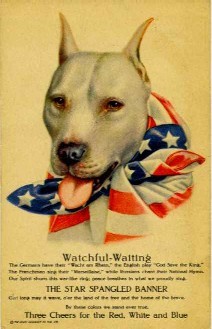 |
| An American Pit Bull Terrier draped in the American Stars and Stripes with subheadings reciting what could also be considered breed standards. |
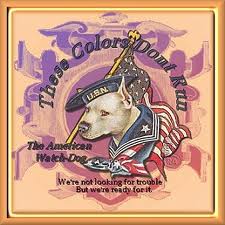 |
| This one is perhaps my favourite: "We're not looking for trouble But we're ready for it". |
The background of bull baiting and dog fighting leads some people to say that Pit Bulls are innately more dangerous than other breeds. These people argue that Pit Bulls may not show as many overt warning signs prior to a fight, and are less likely to back down from a fight. However, it should be noted that other breeds were also used for bull baiting and dog fighting. Pit Bulls are far from the exception to the rule. That being said, proper socialization from an early age is compulsory.
As they stand today, Pit Bulls have an incredibly wide variation to their appearance. Some are taller and thinner, others are shorter and more stout. However, many of the traits from their (ancient) background persist, such as staunch loyalty, trustworthy and friendliness towards people.
What I find most interesting of this breed is its fall from being the a heroic figure used on propaganda posters, to being banned in certain societies. Do you think the violent background is too much for Pit Bulls to overcome? Or does the way you raise a dog determine its behaviour?


