Showing posts with label #dog training. Show all posts

Sunday, September 1, 2013

Babies and Doggies


My family dog Casper relaxing with our neighbour Andrea. Read my blog post about Casper.
One of the ways dogs come into TAGS is as surrenders. When I originally began volunteering, I would look down on the surrendering families with disdain. However, I have come to really appreciate the people who surrender their dog to be rehomed.

After a few years of volunteering, my attitude toward surrendering families has become "At least they love the dog enough to surrender it to a rescue group." It takes a lot of courage to realize that the dog you own no longer fits into your lifestyle. It takes even more courage do to something about it.

One lifestyle change that leads some families to this decision is the addition of two-legged family members. Babies. Many people are taken off guard by how their family dog, who they have owned together as a couple for years, suddenly changes when the baby arrives.

To further investigate what is really going on, I have asked TAGS founder and certified dog trainer Kathy Asling a few questions regarding the topic.

We often hear from surrendering families that the dog has “changed” and has been acting aggressively. Has the dog in fact changed?

OK, this will be the last photo of Casper,
I swear!
Dogs are often adopted prior to couples having children, which is why it is of the utmost importance to socialize your dog with children of all ages.

These dogs need to become familiar and comfortable with the sounds and the movements of children from newborn to teenager.

If the expectant family has not done their homework preparing the dog for the new arrival, then, yes, you may see behaviour changes. Is this really aggression? In my mind, no. It is more often related to fear and uncertainty. What is this new thing that makes noises and gets my owners to run and give it attention? 

Another common mistake is owners who only give attention to their dog when the baby is asleep. It is important to teach the dog to bond with the child. Giving the dog treats and attention while the baby is awake will help the dog to learn that good things happen when the baby is awake. Walk the dog when you walk the baby, and include the dog in activities with the new baby that are safe.

What advice would you give to a pregnant woman about her dog(s) from here on out?

Socialize, socialize, socialize! Ask friends and family, neighbours who have young children to work with you and your dog. Prepare the dog with baby sounds—these can be purchased or downloaded—and play them over and over so the dog becomes familiar with them. Reward the dog with attention and treats as these sounds play.  

Help your dog not to feel anxiety when they hear baby crying noises or laughter or screaming. Teach your dog boundaries—are they allowed in the baby's room? Let them smell the baby's clothes, blankets.... We all know that smell is a high form of communication in dogs, so help them to get used to these new smells. 

And role play. Yep! Grab a doll, wrap it up in a receiving blanket and go through the same motions you will be doing with the new baby.  

Help the dog to get used to the routine.  

I also strongly suggest that if you have a dog that is very dependent on you for entertainment, start finding toys that will provide the mental stimulation your dog needs without you. There are many great products on the market today. 


And of course teach your dog basic commands: sit/stay, down/stay.This will become very important when the baby starts to crawl and walk. Because they stumble and fall, a lot of dogs become very nervous, so teach your dog a boundary of 4-5 feet away from the baby unless you invite the dog in closer.  

Never, never, never, leave a dog and child unattended. That should go without saying. 

What is the best way to introduce a dog to the new family member?

When the big day comes and you are coming home with the new baby, be prepared that Fido will be very excited. Any of us who own dogs know that when we leave and return, our dogs are always happy to greet us.

Trusting that you have done all your prep work already, the dog should be fairly calm. As long as the dog is behaving calmly, you can hold the baby in your arms and allow the dog to gently smell the baby. Ask the dog to sit and offer a very yummy reward, something your dog doesn't normally get but that is very high in reward, like pieces of chicken. 

As long as the dog behaves calmly, keep giving this wonderful reward. What does Fido learn? Yum! I like this “new thing”—I get great treats when it's around!

It's always a good idea to ask someone to bring home a blanket that has been around the baby at the hospital so the dog has a chance to get the scent of the baby before you arrive home.

Does the age of the dog matter? (Can an old dog learn new tricks?)

Absolutely they can. Over the years, I have had many older dogs come to classes. Most have never been taught formally before. Regardless of the age of your dog, dogs love to learn. They need mental stimulation just as much as physical. Teaching an older dog can give them purpose and add some spice in their lives.

Today we hear of people in their 80s and 90s getting degrees, so whether it's humans or animals, never underestimate them because of their age. 

Tuesday, August 13, 2013

Tips to Prevent Dogs From Getting Lost


Limit Their Chance to Escape! 

Lindsey Sjouwerman – Marketing Coordinator at Speepdro Imaging Durham 

Making sure your house and backyard are dog-proof is a crucial step that many dog owners miss. All dogs are different—some dogs are lazy, but others are crafty and will do anything to get out. That could mean digging their way under your fence, jumping over it or straight up opening the latch. They may play dumb, but don’t let that lull you into a false sense of safety—unless you take precautions, all dogs will get out if they desperately want to.

The first thing to understand is what kind of dog you own: a digger, a jumper or a chewer? This will dictate how you dog-proof your backyard. Of course, there are items that all backyards should have to ensure your dog doesn’t escape:
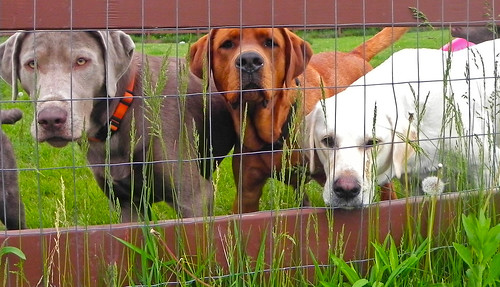
Dogs checking out the action at the fence. CC Tristan Honscheid on Flickr

  • An automatically shutting gate, widely available from any hardware store (tension in the springs forces the door closed so that you don't accidentally leave the gate open)
  • Limited access to your backyard through only one gate
  • No holes or other potential escape routes
Other options that pet owners can invest in include obedience training. The best practice of all is to practise awareness and make a conscious effort to protect your furry friends. When children share the yard, it is a bit harder to address the dangers, but try. The sheer idea of losing a dog because it got out may be enough for children to remember to close the gate or leave the dog in the house.

In my opinion, the best way to ensure the dog doesn't get out is to spend quality time with your pup. Go for walks or play fetch or any activity that will tire him or her out. Essentially, give your dog something else to look forward to. Stimulate the mind, so your dog doesn’t have to search for his or her own stimulation in the form of escape.


Monday, July 22, 2013

Featured Adoptable Dog: Izzy

Izzy arrived at The Animal Guardian Society in February from a Port Perry pound. We don't know much about her background from before that. All we know is that this long-legged puppy was very shy at first. She was intimidated by everyone except her foster mom. Eventually, she came out of her shell, showing her sweet, goofy side.

Izzy's Hobbies
Izzy at PetSmart, looking for adopters
Izzy is easily amused. Her elation at finding in her backyard a water bottle with a little bit of water in it was immeasurable. She was rolling it, biting it, then rolling it again—for about two hours! In the end, she went back in the house, exhausted like a kid after a big playdate. She also considers it her duty to carry big tree branches in her mouth during her walks.

The beagle in her is definitely apparent, as she likes to chase squirrels. And due to Izzy's long legs, paired with a high energy level, her foster mom says that Izzy would be very talented at agility if her new owners decided to try that.

Walks
Izzy sometimes pulls on her walks but is showing improvement every time, thanks to her foster mom's tireless efforts.

Friends
Sweet baby girl sleeping.
Izzy loves other dogs and is becoming more and more social with them. She goes up to other dogs during her walks to get to know them. She also has experience with cats, and she doesn't mind them at all. Izzy is very popular among children, and she lets them overload her with love like a cool pop star. We would still recommend that she be in a family with older kids due to her jumping habits.

And speaking of that, Izzy loves to jump! She could jump over a four-foot fence without any problem. If you are interested in Izzy, you must have a fence that is maybe even higher than five feet and secure at the bottom, too. 

While she is a wonderful, lovable dog, Izzy has a little baggage, too. She still sometimes barks at men, but she is friendly toward men she already knows. She also suffers from separation anxiety, but as soon as she gets into her crate, she relaxes. The person who accepts both Izzy's goofy, fun side and her troubles will surely have a remarkable relationship with a loyal companion. 
"Okay. Now where is my dinner?"

Overall, her foster mom recommends that Izzy would do best in
... a physically active household
... a home with a high fence
... a home with another dog

If you think Izzy may be the dog for you, don't hesitate to fill out an adoption application form so you can meet her! More details about her can be found on our website.

If you want to see more photos of Izzy, click here to explore our Pinterest or Instagram photos!
Adopt Izzy!

Monday, July 15, 2013

The Joys of Walking Your Dog

The Dog Daily: Health Care

By Liz Palika for The Dog Daily
Many dog owners seem to feel that walking their dog is something that must be done; a chore that goes along with dog ownership. But walking your dog doesn't have to be a chore—it can be so much more. When you're out walking your dog, you are spending time together, interacting with each other, and sharing the sights and sounds of the world around you.

The Joys of Walking Your DogThe time spent walking your dog is also a great time to refresh training skills. Obviously, walking your dog is no fun if she is dragging you down the street, so teaching her to walk nicely on the leash is a good skill to emphasize. Have a few treats in one pocket, or if your dog isn't really motivated by treats, take a favorite small toy. When your dog begins to surge forward on the leash (before she is pulling hard), show her the treat or toy, tell her "Sweetie, watch me!" and make a 180-degree turn. Use the treat or toy to make sure she turns with you, and praise her, "Good girl! Super!" Give her the treat or let her play with her toy for a few moments. After a few surprising turns, she will begin to keep an eye on you when you're out walking. When she does, praise her.

Walking your dog is a wonderful time to meet and greet your neighbors. To protect your neighbors from your dog's enthusiastic greetings and dirty paws, teach your dog to sit when people greet her by holding her collar with one hand and tucking her hips under her with the other hand. Don't let your neighbors pet her while she's misbehaving; that would reward her bad behavior. However, once she's sitting (even if you have to help her do it), your neighbors can greet her and make a fuss over her.

You can also give your dog a job to do while walking. You might be amazed at how much satisfaction your dog will get from something as simply as carrying some of your junk mail home from the mailbox! Put a rubber band or two around several pieces of junk mail or advertisements, making the mail into a tube shape. Hand it to your dog and tell her, "Take it!" and encourage her to follow you with it. Praise her, "Good girl to take it! Super!" Begin by having her carry it just a few steps and make a big deal over her efforts. With praise and encouragement, she will be able to carry it longer, or even to carry a small bag home from the grocery store.

Walking your dog is so much more than just a chore. While walking your dog you are outside in the fresh air, you're getting some exercise, you're meeting people and you're practicing your dog's social and training skills. All these things are wonderful ways to strengthen your relationship with your dog.

—Liz Palika

Friday, July 12, 2013

One Furry Reason to Foster Dogs

Here is a touching story from one of our foster volunteers, Chris Stones. It's amazing how the smallest things can mean the world to some of our rescue dogs.

Suzy Q is up for adoption! Photo: Heather
Last night Sheila and I were in bed watching TV as we normally do when Suzy Q suddenly decided to jump up on the bed and join us. That is a normal occurrence with Fred and Mia, our other two dogs, but for Suzy it was huge. She has suffered a tremendous trauma at some time in her life that has left her timid, scared and very wary of just about anything that walks on two legs, especially men. As foster parents, we are responsible for reintroducing Suzy Q to the real world and helping her forget the past and change her behaviour so she can once again enjoy the company of other dogs and people.


When we first got her, she took 15 minutes just to come out of her crate. She now roams freely about our home and plays with Fred and Mia constantly, and her trust factor with people improves every day.

Her jumping on the bed last night was like having your own child take their first step. It was like that moment when you are introduced to a small baby and they hang on to your finger for dear life. It was at that moment both Sheila and I realized that while we had seen small improvements every day, Suzy Q, while still timid and shy, trusts us and others. Now the task of rehabilitation can really start.

Suzy Q
I believe most of us would like to belong to something bigger—to give back to the universe even if just in a small way. This is our first foster, and while we will be very sad when Suzy Q is adopted, we will also be so proud of the strides she has made toward  being a balanced little dog. Her confidence, her trust factor, her personality, her playfulness get stronger every day, and we know it is partly because we have taken the time to care, taken the time to share our home and taken the time to share our own little pack of humans and animals with another animal that needed help to realize her full potential. When we uplift anything, another person, a child, an animal, or when we help anything that shares this planet with us, we give back to the universe around us, and what we get back is immeasurable.

I almost cried a little when Suzy Q jumped on the bed last night. I was so proud of her. She overcame her fear, ignored her gut feeling and took a chance. Imagine if that is all any of us did, to help another to overcome fear and take a chance . . . what an amazing world this would be.

Wednesday, July 3, 2013

Wordless Wednesday: Pooped Pooches!

(photo courtesy of Blossum & Chappie's mom, Courtney.)

Siblings Blossum and Chappie take a well-deserved
rest on the pause table after their agility class.
-      -      - 

This is a blog hop.

Check out the other participating blogs as well by clicking on the image below.


Monday, June 24, 2013

Agility: Fun for You and Your Dog!

This week, TAGS is launching its first ever agility course with trainer Emma Joynson! This series of six classes is only $120 and starts Wednesday, June 26, at 7 p.m.

What is agility? you may ask. Agility is a fun dog sport through which the dog and handler work together to complete an obstacle course.  In this six-week course, as the handler, you will learn to train your dog to run through tunnels and chutes, leap over jumps, and climb a teeter-totter, among other things—all on your command.
Emma and her dog Cobain (Coby to some)


We asked Emma to give us a little more information about agility and who could participate in agility training.

TAGS: What are the benefits of agility training?
Emma: The benefits are countless. First, the bond that is formed between dog and owner by working together is a major benefit. Agility brings together many aspects, including obedience, focus and drive. The end result is the dog being worked both physically and mentally, which is essential to a happy dog. Both dog and owner are learning and getting exercise in a fun and safe environment.


TAGS: What skills does my dog need to have to begin agility training?
Emma:
To start agility training, only the essentials are needed. I think the two most important are a decent sit/stay and recall (neither of which need to be absolutely perfect, of course, but the basic knowledge should be there).


TAGS: Can an old dog learn agility?
Emma: Yes! Any dog of any age, breed or size can learn and excel in agility!

TAGS: What if I’m not in shape? Can I still do agility with my dog? What skills do I need to have?
Emma: The beauty of agility is that you don’t have to be in shape to participate! While the sport certainly will get you out and moving, we will go over skill sets and training techniques that will assist you in participating in agility without having to be a marathon runner.


If you’ve read this and still aren’t sure, here are some videos of dogs running in starter-level agility trials: Hogan’s first trial and Chelsea’s first qualifying run. With only a couple months of training, your dog can participate in a trial, too! Our one word of caution for you: Agility can be addictive!

For more info or to sign up, call 905-263-TAGS or email tagsinfo@yahoo.ca.
Blogging tips