Showing posts with label caring for pets. Show all posts

Monday, October 28, 2013

In the Defence of Quincy

Last Saturday, I had my monthly PetSmart shift. I was at the Whitby location with another volunteer and two adoptable dogs, Colt and Quincy.

As usual, the dogs are what attracted customers over to the TAGS booth. Then, we humans took over, answering questions about the pets up for adoption, the adoption process and our need for more foster homes. It was a pretty standard shift, complete with lots of doggy eye-candy (I love seeing all of the different dogs and their owners walk through the door!)

Tell me there isn't some teddy bear in there. 
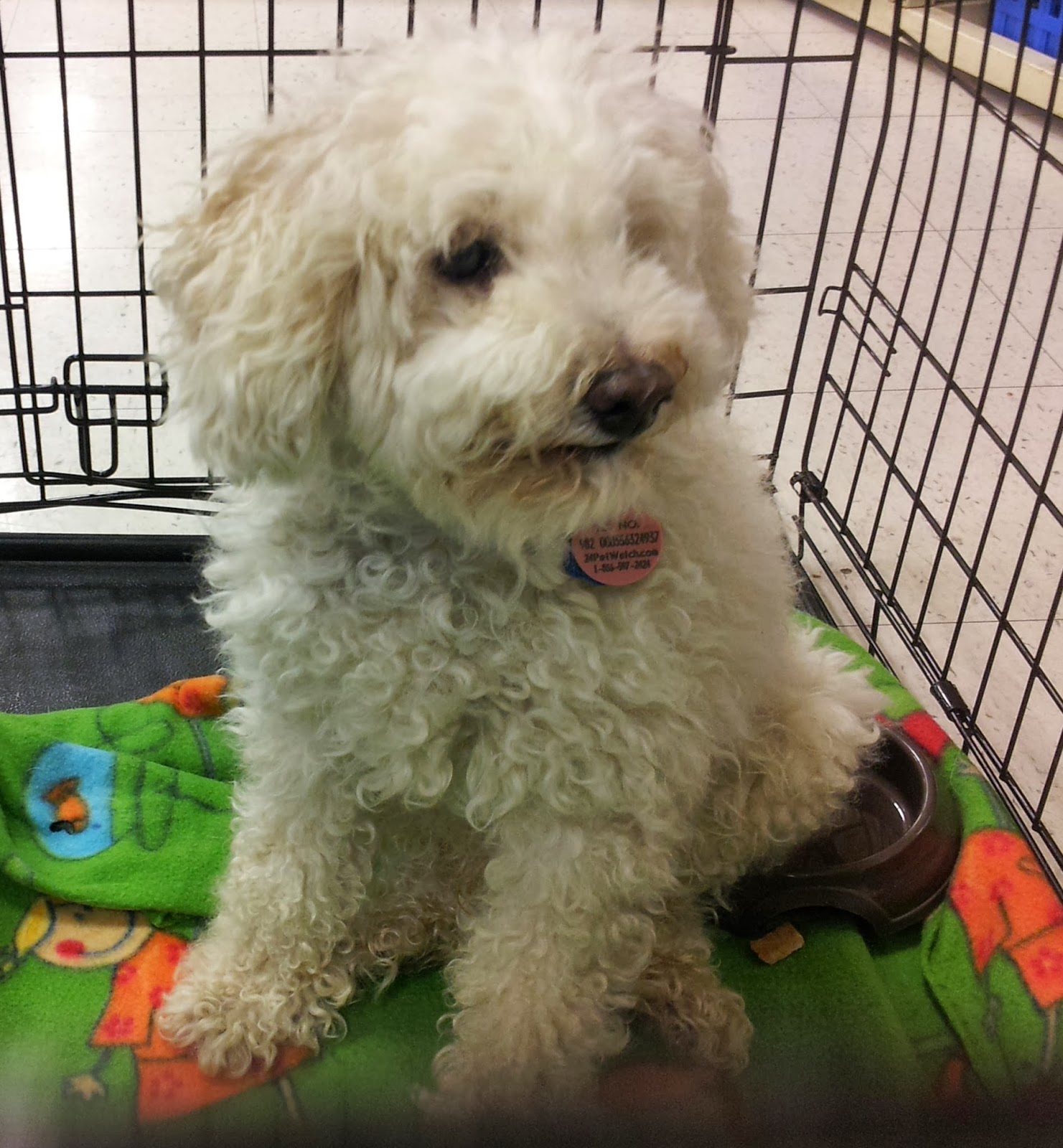
But this time, in addition to answering the standard questions, I spent a fair bit of my four hour shift defending Quincy, a 10-year old Bichon Frise/Mini Poodle mix who from some angles looks like he could also be mixed with teddy bear. Why would I feel the need to defend such a cutie? Well, Quincy no longer has any of his teeth, and as a result he shakes/rotates his head often and plays with his tongue. It's almost as if his tongue falls out of his mouth, and he tries to get it back in. I suppose at first glance, it is a bit distracting and "weird." I happen to find it very endearing, and found myself imagining that he was listening to a song no one else could hear and couldn't help but head bang along with it.

Nevertheless, I felt like Quincy was repeatedly, and unfairly, judged for this quality and this quality alone. It is normal for people to have questions, and of course, that is what we are there for, to answer questions about the adoptable pets. However, I felt like I rarely got the chance to talk about Quincy's good qualities so I wanted to share them now.


Quincy's qualities
Quincy is a normal dog who will make a fantastic pet when he finds his forever home. Yes, Quincy is a senior, but you would never know it if the lack of teeth didn't give it away. He enjoys playing with his foster siblings and has a youthful personality. When I took him for a pee break outside, he was peppy and eager to sniff everything - even though it was cold and wet outside.

Despite being unable to defend himself, Quincy is polite and well-trained. He let other dogs approach him, and politely approached other dogs in return when we were out for our walk break. While he was exhibiting signs of nervousness in his crate (in the form of adorable squeaking noises) he didn't bark even once during the whole shift. He only seemed to do the tongue thing when he was in the crate or otherwise unoccupied: if distracted by a walk or a toy, you'd never know that he has such a habit.

Quincy showing off his (lack of) pearly whites. 
Where did his teeth go? 
When Quincy was found, he was wandering around a busy street. He was in very rough shape and all of his teeth were rotten and infected right into his gums, which was undoubtedly painful. The decision was made that he would be better off having them all removed. This was back in the summer, and Quincy has been doing great ever since. He doesn't seem to miss his teeth at all and is healthier for it.

(What) does he eat?
A common question I received on Saturday regarding Quincy was, funnily enough, not "what does he eat?" but instead, "Does he eat?" which I found to be quite amusing. Of course he eats! Quincy requires a diet of soft food and even then, it needs to be cut up into very small pieces. It's definitely more work than simply pouring kibble into a bowl. And sometimes Quincy gets bored of soft food, so his foster mom gives him small pieces of kibble that she has soaked in warm water. Putting the mixture through a blender is also a good idea to ensure that he will get his proper nutrients.
                                                                              

A Final Plea
I understand that it can be daunting to take on an animal with special needs, but I can assure you after spending some time with this guy that the pros outweigh the cons. I hope you will give Quincy, and other dogs you meet who may be a bit "different," a chance to be welcomed into your home. I believe without a doubt that Quincy would make a great pet. I hope he finds his forever home soon, where he can settle in and peacefully spend the rest of his days, head shakes and all. 

Monday, October 21, 2013

Safety Tips for Spooky Times

In 10 short days from now, critters and monsters of all sorts will be roaming the streets and knocking on doors looking for their sugar fix. Whether you are planning to go all out for Hallowe’en with decorations, or if you just intend to have candy in a bowl at the door, if you are a pet owner, you should be aware of some potential dangers.

Bosco is glum. He wanted to be a clown
for Hallowe'en but the nose wouldn't fit.
Trick or Treating
Most dogs get pretty excited when they hear a knock at the door. To make sure they don’t run outside or become overwhelmed with the excitement of their first dinosaur sighting, consider putting up a gate so they can’t get too close to the trick or treaters. Alternatively, if you think they won’t become too anxious (some pups like to know what is going on), you can keep them in the basement or in a separate room. It is not recommended that they stay in the backyard. While most of the people out and about are just kids in costume, Hallowe’en night is also a time when vicious pranksters like to get their thrills. Keep your pets safe by having them inside, or with you, at all times. Similarly, if you have outdoor cats, it is highly recommended that you keep them indoors for several days before and after October 31.

If you are going trick or treating with the little ones and would like to bring your dog along, consider getting them a collar or leash with LED lights so they are easily spotted. Don’t forget treats and clean-up bags!

Hallowe’en Decorations and Costumes
 Josie didn't want to be anything scary,
so she's going as a ladybug.
Be aware of the decorations you are putting up around the inside and outside of the house. Wires and electrical decorations are dangerous for your pets because they may want to chew or pull on them. Blow-up decorations and plastic skeletons may seem like a bonus-size chew toy for your pet, but if they haven’t been made with pets in mind, they might be unsafe. Lastly, while we all love the glow of a Jack o’Lantern, the flickering lights and interesting smell are enough to make any animal curious. Avoid injury by using flame-less LED tea lights, which are available at stores like Walmart.

If you’re going to dress up your pet, try on their costume in advance. Make sure it doesn't itch or irritate them anywhere, and if they seem upset or restricted, a decorative bandana may be a better option.

Candy
After the trick or treating has come to an end, remember to keep the Hallowe’en haul out of your pets’ reach. Chocolate and candy should never be ingested by dogs and cats and the wrappers are very dangerous for them as well.

Have a safe and Happy Hallowe'en, everyone!  

This blog post was written with help from Pet Valu and PetMD.

Friday, October 11, 2013

The Best Way for Your Dog to Ride in the Car with You


Exceptional Canine: Active Dog

By Stacey Brecher for Exceptional Canine

Ready to hit the road with your dog? Before you put the car into drive, it’s important to make sure that your dog is safe. Some options for properly restraining your dog while in the car are in a crate, a harness or a seat belt.

Using a Crate
The Best Way for Your Dog to Ride in the Car with YouIf you decide to keep your dog in a crate for the duration of the car ride, and your vehicle has enough room to stow it, the crate should be large enough for your dog to lie down or stand up and turn around. Bill Rabenberg, owner/trainer at Red Iron Kennels of Manor, Texas explains: “You must also ensure the crate is not so large that the dog can easily be tossed around inside,” he said. “It’s helpful to include a soft crate-bed to provide padding for the dog to lie on, but torn newspapers or cedar shavings also provide a soft spot for animals still learning to ride without getting carsick, and these make cleaning up a snap.”
Keeping your dog in a crate stops your pet from moving around the vehicle while it’s in motion, and also prevents him and you from injury during a sudden stop or accident.

Where to Let Them Ride
The safest place for your dog is in the back seat of the car. You can easily install a harness or dog seat belt to keep your pet from climbing into the front seat. “Some pets are difficult to manage when nervous, and may suddenly climb onto the driver's lap, interfere with driving or jump down below the driver’s legs, obstructing his ability to reach the gas and brake pedals and possibly causing an accident,” Rabenberg says.
Another reason to keep your pet in the back seat is the danger from the force of a deployed airbag.

Dealing With Fear and Car Sickness
Many dogs are afraid of riding in the car or are apt to get carsick, but there are steps you can take to teach your dog that car rides are fun. Rabenberg suggests allowing the dog to sit in the car in the back seat while you sit in the front seat until he relaxes and then you can pet or reward him. After trying this for a few days, you can turn on the car but not drive anywhere. “After several successful attempts on several days, go for a short drive, just around the block,” Rabenberg says. “When you arrive home, take some time to pet and talk to your pet before getting out of the car, so he knows his reward comes with remaining in the vehicle, not rushing to get out. Repeat this several days in a row, then slowly expand your trips, making them a few blocks longer, and finally take him to a fun location, gradually increasing the distances.”
Allowing your dog to feel more comfortable in a moving car will lower his stress level and prevent accidents in the car.
Dogs enjoy the feel of a breeze coming from the car windows on their faces, too, so feel free to leave the window open, as long as your dog is properly restrained. If not, keep the windows closed to prevent him from falling or jumping out.
Your dog may be unhappy at first, but with a little time and patience he will soon become used to the restraint and look forward to your next car ride adventure. 

Stacey Brecher is an editor at Woman’s World magazine, and a contributor to Animal Fair magazine. Stacey's blogs have previously appeared on Exceptional Canine.

Friday, July 5, 2013

Interesting Facts About Whiskers

  • Whiskers are not the same as fur or hair. They are thicker at the base than fur and get thinner as they extend. They feel harder than fur, and the base can feel almost as strong as the point of a safety pin (but not as sharp).
  • Whiskers are sensory in nature and are rooted much deeper than normal hair. They can sense distance and space, and they feel through vibration. 
  • Whiskers can be hard to see depending on dog's or cat's markings, but once they’re spotted, it’s amazing how many whiskers you will notice! And they don’t just come out around the nose, but also above the eyes and under the chin.

    My purrbaby Milo showing off her whiskers.
    She has way more than you might think at first glance! 
  • Cats and dogs use their whiskers to feel their way around the world. When trying to fit into small spaces, cats determine if their body will fit based on whether their whiskers fit. That’s why when your cat has a cone around her head after a vet visit, she might act very disoriented or use the walls to get around. She can’t “see” the same without her whiskers! 
  • Interestingly, mother cats use this knowledge to their advantage when their kittens are small. While grooming, a mother cat will often nibble the whiskers of her babies until they are very short to keep them from wandering away from her. It has also been reported that cats who live together have done this to one another as an expression of dominance. 
  • Despite what the mama cats may do, you should never trim or pluck your dog's or cat’s whiskers. Whiskers will fall out sometimes, but this occurs naturally, like shedding. Cutting or plucking out whiskers before they are ready to fall out not only will cause your pet to become disoriented (and probably stressed) for a few days but can also cause infection. There are many medical problems that could arise if whiskers are plucked, such as the exposed nerve mound becoming infected.

    Noelle has long whiskers that blend into her face.
    (Noelle is available for adoption.)
  • Dogs and cats with reduced vision are especially dependent on their whiskers, which guide them through the world in much the same way that humans with vision impairment have reported that their hearing skills have improved with the diminishment of the other sense.
  • Be careful at the groomer's! Some groomers are in the practice of trimming the whiskers of dogs to make their face look “neat and tidy.” When dropping your dog off for a day at the spa, be sure to mention that you do not want his whiskers touched. Hopefully, the groomer will be surprised you even mentioned it, as he or she didn’t plan on doing that anyway, but it’s better to be safe than sorry! 

Friday, April 19, 2013

Why Spay or Neuter

Source: CSRA Humane Society

Neutering refers to the removal of an animal’s reproductive organs and is a term used in reference to males, whereas spaying is used in reference to females.

Why Spay or Neuter?

Since TAGS is a rescue, most of the dogs and cats in our program have come from shelters. Shelters are brimming with unwanted dogs and cats—and to my surprise, many are puppies and young dogs! Pregnant female dogs or a litter of puppies can often be found at shelters due to an accidental breeding situation. Spaying or neutering your pet is the most effective way to help control the pet population and save animals from euthanasia in shelters.

Every year, thousands of dogs and cats are euthanized because there is simply not enough room for them in shelters. Additionally, several thousand animals from shelters every year are used for experimentation (research, teaching and testing) purposes. Although Ontario has laws to protect shelter animals from such a fate, there are other provinces where such laws do not exist to protect these vulnerable animals.

Benefits

Spaying and neutering have several benefits for your pet’s health. Spaying females prior to their first heat cycle can eliminate the risk of breast cancer and prevents uterine infections and uterine cancer, thereby reducing veterinary costs. Neutering males helps reduce or prevent testicular cancer and enlargement of the prostate gland—also helping to reduce future veterinary costs. Additionally, neutering your male dog can help prevent undesirable behaviours such as marking, humping, male aggression and an urge to roam. Also, if you have more than one pet in your household, spaying or neutering will help all the animals in the house get along better.

Costs

One of the biggest issues around neutering an animal is the costs associated with the procedure. If you live in Durham Region, there are many veterinarians who provide an affordable service and will often give out their rates over the phone. Additionally, the Ontario SPCA provides spay/neuter services at a much reduced price—however, wait times for these spots are high, so I recommend getting on the wait list as soon as possible if you are considering going this route. Spaying and neutering can be done as early as eight weeks old; however, any time between eight weeks and six months is optimal, especially for females due to the beginning of their heat cycles.

There are many benefits to neutering your animal—but the biggest one is the ability to help save the lives of perfectly healthy but unwanted shelter animals. Do your part and help save a life!


Tuesday, March 12, 2013

Bach Flower Remedies for Pets

Help Your Pets Overcome Their Depression or Anxiety With Bach Flower Remedies

Our pets can get just as depressed or nervous as we do. Lots of situations can bring their sad side out, like the absence or loss of an owner or someone who was close to them. They can get nervous simply from going to the vet or from fireworks outside.
CC image courtesy of Lulu Hoeller on Flickr

Unfortunately, we can't make them understand that the fireworks are harmless and will go away and that only time can cure the sorrow after a beloved one's loss.

If you want to soothe your pet's nerves, TAGS recommends using Bach flower remedies, a natural option to help your pet (or even yourself) overcome such emotions. These remedies were developed by Edward Bach in the 1930s. Bach discovered that the dew found on the petals of flowers contains the healing properties of that plant.

The remedies nowadays are made from spring water infused with wildflowers, and the ones that are safe for animals (alcohol free) are preserved with glycerin. They are considered vibrational medicines and rely on the concept of "water memory." Despite often being labelled as homeopathic, they do not bear the same characteristics.

CC image courtesy of Desi on Flickr
The most common flower remedy is the Rescue Remedy, which is a mix of five Bach flower remedies:
  • Star of Bethlehem
  • Rock rose
  • Cherry plum
  • Impatiens
  • Clematis
 You can read more about these remedies here.

This is a great and natural solution to help soothe the mind of you and your pets!

Monday, February 25, 2013

A Microchip Session in Photos

TAGS can microchip your pet for only $30 at various Pet Valu locations. Find out more about microchipping from this blog post or visit our website for microchipping dates.

Promotional poster
Promotional poster of one of our microchip clinics
Waiting for customers
TAGS volunteers (and Boomer) waiting for customers
TAGS bulletin board
TAGS bulletin board at the entrance of the clinic
Needle
Needle (still in the protective cap) attached to a plunger gun
Needle close-up
A close-up of the needle
First microchip
This cat came to get his microchip!
Check for microchip
First, we make sure he doesn't already have a microchip.
Rub the area
We rub some alcohol in the area where the needle will be inserted.
Click on the video to see how fast and painlessly we insert the microchip! It takes no more than eight seconds!

Friday, February 15, 2013

How to Start Fostering with TAGS: FAQ

Are you considering fostering but don't know where to start? TAGS volunteers and foster parents are ready to help you set up for your first experience saving a dog's (or cat's) life!

How do I know if I qualify to be a foster parent?
Do you love pets? Do you have a house or an apartment with enough space in it? Do you have enough time to walk your foster dog and spend quality time with him or her on a daily basis? If your answers are yes to these questions, then you probably qualify.

Finding a perfect foster match is an important part of the foster program. By getting to know foster families better, we can help to choose the foster dog or cat that best suits the family. Foster animals come from all walks of life, some with history, most without. As is our goal with our adoption process, we want to work with our foster families to ensure that their experience as a foster is one that proves to be rewarding. 

What do I need to do to apply?
First, fill out this application form. 

Is this considered a form of volunteering?
Yes! Many people are not able to make time for volunteering in the traditional way, but fostering is a great opportunity for you to help out without having to change your daily routine a whole lot.

What if I already have a dog?
That shouldn't be a problem. It often even helps to have another dog for your foster dog to socialize with. 

What if I have a cat that doesn't like dogs? 
You can either try to slowly allow your cat to get used to the presence of a dog or foster a suitable cat.
 
Can I foster only cats?
Yes! If you prefer, you can apply to be a foster home for cats. TAGS doesn't have many, but there is always a need to save some. 

How fast will I get a dog?
It depends. Almost daily, we get notifications about dogs that are available to take from pounds, so it could happen as quickly as a couple of days after approval.

Are these dogs vetted/groomed before or after I get them?
We always try our best to have the new dogs checked out by a vet beforehand. However, sometimes there are emergency cases, in which we must place a dog somewhere before he or she gets a veterinary appointment.

How much of the expenses are covered by TAGS?
100% of the expenses are covered by TAGS, including medical care, food and treats, bedding, grooming and training.
 
What kind of dog food does TAGS use?
TAGS uses high-quality dog foods.


Some people foster lots of dogs! Quin & Rye (on the right&middle) 
are adoptable
How do I attain the dog food?
You can pick up your share from our dog park. Please ask for directions.

What other duties do I have as a foster parent?
Other than providing a loving foster home and doing some basic training (our training experts can help) with your foster dog, you are required to transport your pet to either the Whitby or Oshawa location of PetSmart for a dog showcase at least once a month. TAGS presents its adoptable pets at PetSmart every weekend so that people can get to know our organization and animals a little better.

There are also other events to which you may be required to bring your foster dog—for example, TV promotions or a puppy room event for university students, if your schedule allows.

Can I rename my foster dog?
Yes. Actually, our foster parents made up a Scrabble-like game to give more creative names to the newcomer dogs. But if you want, you can keep his or her original name.

What if I want to adopt my foster dog?
TAGS has a rule that you cannot adopt your first foster dog. But you can adopt your second (or any subsequent) one.

It's important to understand that by fostering, you are saving not just the fostered dog's life but potentially the life of another dog, too, who is still in a shelter waiting for a foster home to become available.


If you have any other questions, please let us know in the comments section!

Monday, January 21, 2013

Dear TAGS: What's the best method against pulling?

Hilary asked:


I have had a few people recommend a certain way of putting on our dog’s leash to reduce his pulling. Basically it's as follows: run the leash along the dog’s back to its hips; wrap the leash around the dog’s waist under its belly and loop the leash through itself to make a slip tie (it has a special name but I can't remember what!). This technique has worked wonders for us and results in much less pulling; however, my husband is concerned about the pressure of the leash on our dog’s waist/hips. What is your take on this technique? Do you recommend it?

Our certified trainer answered:

To find out if that method of using a leash could harm your dog, you should consult your veterinarian. However, there are many other options available that will most certainly help you keep your dog from pulling.

One of the primary reasons people attend our classes is to address a dog that pulls them off their feet or acts “aggressive” on leash. If you haven’t yet taken an obedience class, you could start with that.

But there are also great tools on the market to help you teach your dog how not to pull. Which one is right for you is a personal decision.

Dog with gentle leader. CC image courtesy of krossbow on Flickr.
I have always used the veterinarian-developed Gentle Leader head halter.  When the Gentle Leader first hit the market, it was sold only through veterinarians and trainers, who would ensure a proper fit for the dog. Now pet stores are selling them, and I have a concern that they are not fit and used properly. The principle behind the Gentle Leader is simple: control the head, control the dog.

Several years ago, anti-pull harnesses hit the market. They offered a different approach. Rather than using a halter-style, the harness was designed to cover the dog’s body to reduce the dog from pulling. They work well, and I have never heard of any issues with them. Again, remember these are special harnesses for teaching dogs not to pull; they are not a regular-style harness, which will make some dogs pull more.
Dusty pulls a lot less with this special type of harness

In the old days, choke collars were used, and we were taught to “correct” the dog by snapping the chain until the dog responded to our command. I would never use a choke collar or a pinch collar! Why would we use tools that can harm our dogs and that most pet owners do not use correctly?

So, ultimately, what is the goal? Most owners are happy to use the tool that eliminates the pulling—end of story. As a trainer, though, I ask, Is your dog learning? Tools should be used to teach your dog. And they must be used correctly. Walks are opportunities for training, challenging and rewarding your pet. Make the most of them!

If you have any questions concerning your pet, send us an email or ask it on Facebook or  Twitter or in the comment section below.

Friday, January 18, 2013

Top 5 Fun Winter Activities to Do With Your Dog

Despite the weather getting colder and colder, make some time to exercise with your dog. When it's mild and calm outside (usually right after it snows), grab your jacket and your dog and get out of the house for some playtime! 

Aside from the usual snowball throwing, there are other creative ways to tire the dog (and yourself) out.

Dawson is up for adoption. Like his photo on Facebook!

1. Hide-'n'-seek. Dogs are just like kids: they love to play hide-'n'-seek. Hide somewhere and call your dog's name until he finds you. It's a good practice for his obedience training, too.

2. Play in the snow. Your dog will find it hilarious to see you lie down and make a snow angel next to him. He will probably want to help you, so watch out for his wet kisses and cold nose!

3. Run. Race to the park with your dog. Dogs love a challenge! They love to get their muscles moving, and they are surely in need of some exercise after being in the house all day.

4. Under the snow. If you have durable, water-repellent gloves, then grab a stick and shove it under the snow. Start moving the stick right under the surface of the snow level so that your dog can see the movement. He'll have great fun trying to catch the mysterious, hidden object!

5. Socialize. Arrange a play date with a friend who also has a dog. Dogs are social beings who like to spend time with fellow furry friends. Let them chase each other and play games while you catch up with your friend!

These simple games do not require any tools that you have to purchase. However, you should always make sure that your dog is warm enough during your playtime, especially if he has short hair. Also, check the roads beforehand to determine whether walking on them is safe for your dog (salt or ice can be dangerous). Have fun!


Monday, January 14, 2013

TAGS Educates

TAGS feels that it's important to always educate people about pets. It seems easy to own a dog or a cat, but there is much more to it. We can always improve ourselves to better understand our furry companions. 

Chappie and Blossum (recently adopted) just graduated! Good job!
Hence, TAGS introduced a Dear TAGS section in the blog where you can send your questions about your dog's or cat's behaviour or any other topic that you might be interested in. Our certified trainers are ready to answer you! Submit your questions here.

TAGS is now officially back from the holiday vacation, which means that we are ready to launch our winter classes! Our first session starts on the 19th of January and is held in our dog park. Don't miss out—you can still apply by emailing us here or calling us at 905-263-TAGS (8247). 

You'll learn how to read your dog's reactions and how to communicate with him more effectively. If you want to read TAGS-approved training tips, please click here.

TAGS will always make sure that your dog feels comfortable and never threatened while being trained. To find out why TAGS disassociates itself from punitive techniques, read this informative blog post.

We'll also have puppy classes at Pet Valu starting on March 7. These classes will be most suitable for puppies of 8-12 weeks, so if you own a newborn dog, you can already mark your calendar for this date! More info will be posted as the date approaches. 

Friday, December 28, 2012

New Year's Eve Fireworks—What to Do If Your Dog Runs Away

Fireworks - CC image courtesy of bortescristian on Flickr
New Year's Eve is almost here, and so is snow and freezing cold! You have to leave the house with several layers of clothing just to make sure you won't get cold. Does it sound familiar? Imagine if you are not prepared at all and have to spend some nights out there in a snowstorm. A runaway pet might face a situation like this.

It's very important to make sure that your dog (or even cat) is in a warm, cozy and secure area during the night of New Year's Eve. It's a lot of fun for people to put on fireworks displays, but our pets may not feel the same. Some more sensitive dogs or cats can get so frightened by all the noises that they decide to run away from all this craziness.

Tips to Prevent Pets From Running Away:
- If your dog is an outside dog, double-check any weak parts of the fence.
- Give him or her warm blankets for extra coziness in the doghouse. With all the noises going on on the streets, your dog might feel safer in his or her comfy hideaway.
- Play or walk with your dog in the afternoon so that he or she will sleep deeper at night. 

8 Tips If the Dog Has Already Run Away:
1. Don't panic! First of all, put some water and a blanket by the part of the fence where the dog escaped from, just in case he comes home. 

2. Call up some of your friends and start exploring the neighbourhood. 

3. At least one person should stay at home to keep an eye on the property and the street and to be available in case someone returns the dog or calls the number on his tag.

Dog hiding from fireworks - CC image courtesy of Dave Parker on Flickr
4. When out on the search, call his name out and have a treat ready. Be extra careful around busy areas, though. You don't want your dog to see you and start crossing the road with the risk of being hit by a car. If you spot him, try to approach him without his noticing you.

5. Don't forget to take his leash, water and a blanket with you so that you can help him right away when you find him. Read our cold weather tips for dogs. Additionally, a flashlight for searching culverts, etc., and a squeaky toy to draw him out can come in handy.

6. Make sure you have your veterinarian's or an animal hospital's number with you. Roaming the streets alone in the dark is very dangerous for any dog. Read about dog first-aid here or here.

7. If he's been missing for more than a day, start putting "missing dog" posters out in your community and run a listing in the local newspaper. Register him on helpinglostpets.com and post his picture on Facebook and Twitter. Ask your friends to share it so more locals will see it.

8. Contact the local shelters and let them know about the situation so they can call you as soon as someone shows up with your dog.

Friday, November 16, 2012

Pet First-Aid 101

Last weekend, TAGS hosted a pet first-aid course taught by veterinarian Tanya Varley from Morningside Pet Hospital. Twenty pet-loving people and about 14 tail-wagging dogs attended the all-day event at the Quality Suites at Bloor and Grandview.

Checking Merlin the greyhound's gums.
Through the course of the day, participants learned and practised such important skills as taking a pet’s vital signs (heart rate, respiration rate, temperature), bandaging a wound and performing CPR. Did you know that a dog’s normal body temperature is a little higher than a human’s and a temperature below 37°C or above 39°C is potential cause for concern? A temperature that’s too high or too low needs to be regulated slowly so that the organs, not just the outer body, can acclimatize. A hypo- or hyperthermic dog should immediately be removed from an environment that is too hot or too cold, and drastic measures (e.g., giving an overheated dog ice cubes) should be avoided.

While the discussion of vital signs was relatively tame, some of the scenarios Dr. Varley presented us with, such as prolapsed eyeballs (not uncommon in pugs, Boston terriers and bulldogs) and impalements, were difficult for the faint of heart, like me, to hear about and see pictures of. But we students all shared a common goal: wanting to do everything in our power to care for and potentially save the lives of our pets in an emergency. And that was enough to quell the squeamishness—well, for the most part.
Annetta practising bandaging techniques on Petunia's paw.

Many important topics were addressed: preventing and treating bloat, managing allergic reactions, inducing vomiting (and when not to), recognizing and dealing with seizures, and—so important for every pet parent to know—determining which symptoms can be dealt with at home and which require an emergency trip to the vet.

The learning experience was great, but spending time with fellow dog people and their dogs is always a major highlight of TAGS events. Most of the dogs greeted each other and their human counterparts with enthusiastic tails. Occasional barking sounded throughout the conference room, but for the most part, the dogs were all well behaved, allowing us to concentrate. By 2:45, after we humans enjoyed a wonderful lunch (included in the course fee), dog after dog lay flaked out on the fur-filled rug, and then around 4:10, all of a sudden, six or so woke with a start and barked up a storm, probably in response to a noise only canine ears could detect. They were easily calmed, and class resumed.
Nikki asking Dr. Varley a question.

That quiet hour and a half before the choral yapping was likely our best opportunity for learning, but it’s also when many of us, I suspect, felt tugs of distraction. There’s just something about a roomful of sleeping dogs that rouses a sense of wonder and love that can sidetrack even the most attentive of us.

Letting sleeping dogs lie.
Fortunately, Dr. Varley provided one enlightening bit of information after another, so refocusing on the task at hand was relatively easy. By the end of the day, we attendees walked away with the invaluable feeling of being better equipped to protect our four-legged loved ones when they need us most.

Pack Your Own First-Aid Kit

Here's what you need:

hydrogen peroxide
rubbing alcohol
Benadryl
saline/contact solution
gauze squares (to use for cleaning wounds/skin, contact layer for bandages)
non-stick pads (to cover wounds)
rolled gauze for bandaging
Vetwrap/klingwrap for bandaging
tweezers (in case of ticks, splinters, etc.)
muzzle, leash
digital thermometer
stethoscope (optional)

And if you missed the course, watch for another one in the spring so you can learn how to use these items!

Blogging tips